
Entity SEO Explained: How Search Engines Understand Your Business Identity

Search engines do not only match words on a page anymore. They try to understand things. This shift is part of the broader evolution of search, from simple keyword matching toward semantic search and contextual understanding.
A business is a thing. A founder is a thing. A product, service, location, award, author, category, and area of expertise can all be things. In search, these things are entities.
That shift matters because modern search is moving from “Which page uses this keyword?” to “Which known source best answers this need?”
Entity SEO is the work of making your business easier to identify, connect, and trust across the web.

Search engines now look for meaning, not just matching words
Traditional search engine work focused heavily on keywords. A bakery might target phrases like “wedding cakes,” “custom birthday cake,” or “bakery near me.” That still matters. People search using words, and pages need to answer those words.
But keywords alone do not explain identity.
A search engine also needs to know:
Who runs the bakery
Where it is located
What it is known for
Which products it offers
Whether other credible sources mention it
How its pages connect to each other
Whether its information is consistent across the web
That is where entities change the game.
An entity is a clearly defined person, place, organization, product, service, or concept. Search engines use entities to understand meaning. They also use relationships between entities.
For example:
A dentist is connected to a clinic.
The clinic is connected to a city.
The city is connected to a service area.
The dentist is connected to qualifications, articles, and patient services.
The clinic is connected to reviews, directory listings, and local mentions.
This gives search engines a richer picture than a page that repeats “dentist in town” ten times.
Entity-based SEO asks a deeper question than keyword research alone. It asks whether a search engine can clearly understand what the business is, what it does, who it serves, and why it should be trusted.
That is the real shift.
Keyword SEO tells search engines what a page is about
Keyword-focused work still has value. It helps match content to search demand. It helps shape page titles, headings, product descriptions, and article topics. But as I explored in Why Ranking First on Google Is No Longer the Ultimate Goal for SEO Success, visibility today is becoming about more than simply securing the top position in traditional search results.
The problem starts when keywords become the whole strategy.
One of the biggest mistakes businesses make is thinking SEO is about making individual pages rank. Modern search increasingly requires you to think about what those pages collectively say about the business behind them.
Here is the difference in plain terms.
Traditional keyword work | Entity-focused work |
Focuses on search phrases | Focuses on people, businesses, places, products, and ideas |
Measures page relevance | Builds business identity and context |
Uses keywords in content | Connects content through meaning and relationships |
Treats pages as separate assets | Treats the website as a connected knowledge source |
Often stops at the website | Looks at consistent signals across the wider web |
Take an online furniture store.
A keyword-led approach might create separate pages for “wooden dining table,” “oak dining table,” and “round kitchen table.” That can work if the pages are useful and distinct.
An entity-led approach goes further. It makes clear that the business sells handmade furniture, serves a national audience, offers custom sizes, uses specific materials, has clear product categories, publishes care guides, and is mentioned by home design publications or trade groups.
The keywords still exist. They sit inside a larger identity system.
That system helps search engines understand that the store is not just a collection of product pages. It is a real business with a defined offer, subject knowledge, and a place in its market.

Relationships are the missing layer in search
Search engines do not understand entities in isolation. They understand them through relationships.
A personal trainer is linked to fitness coaching. A fitness coaching business is linked to a location, training programs, nutrition content, client outcomes, and the trainer’s public profile. A product manufacturer is linked to product lines, materials, retailers, certifications, and industry mentions.
These links build meaning.
A strong entity presence answers questions like:
Is this business the same one mentioned elsewhere?
Does this author have clear expertise in this topic?
Is this service page connected to the main service category?
Does the company information match across trusted sources?
Do outside mentions support the claims on the website?
This is where many businesses fall short.
They publish content, but the content sits in silos. The founder bio does not link to authored articles. Service pages do not link to case examples. Product pages do not connect to buying guides. The about page gives vague claims but no concrete proof. External profiles use different descriptions, categories, names, or locations.
That creates noise.
A search engine should not have to guess whether “J. Smith Consulting,” “Jane Smith Strategy,” and “Smith Growth Advisory” are the same business. It should see a consistent name, clear founder profile, matching services, and credible references.
The same rule applies to companies and personal brands.
A consultant who wants to be known for pricing strategy should have:
A clear bio that states the specific field
Articles on pricing models, buyer behavior, and service packaging
Internal links between those articles and service pages
Consistent public profiles
Mentions from relevant podcasts, trade sites, and event pages
Structured data that identifies the person and organization
No single signal proves authority. The pattern does.
Structured data helps search engines read your identity
Structured data is a way to label details on a website so search engines can read them more easily. It does not replace good content. It supports it.
Schema.org is the shared vocabulary many sites use for this. It gives website owners a standard way to mark up information such as organizations, people, products, articles, services, local businesses, reviews, events, and frequently asked questions.
Think of structured data as a set of labels.
A page may visually show a company name, address, author, product price, and opening hours. A person can understand that from the page layout. A search engine can often infer it. Structured data makes the meaning clearer.
For example, a service business can mark up:
The organization name
Website address
Logo or representative image
Phone number
Service area
Business type
Founder or team members
Services offered
Social and public profile links
An e-commerce site can mark up:
Product name
Product image
Description
Category
Availability
Price
Reviews, where valid and visible on the page
Shipping or return details, where relevant
A personal brand site can mark up:
Person name
Job title or field
Bio page
Articles written
Same public profiles
Business affiliation
Structured data SEO works best when the marked data matches the visible content. If a page says one thing to users and another thing in the code, that creates risk and confusion.
Structured data is not a magic ranking switch. It is a clarity layer. It helps search engines connect facts faster and reduces ambiguity.
That matters more as search results become more answer-led.

AI search needs clear entities to give reliable answers
AI search tools do not only return a list of blue links. They often summarize answers, compare options, and mention sources directly inside the response. But what determines which websites become part of those answers? I explored that question in How AI Search Decides Which Websites to Mention.
That raises the bar.
If a system is going to answer “Who is a reliable tax advisor for small businesses?” or “Which company sells sustainable office furniture nationwide?” it needs more than matching keywords. It needs confidence.
AI Search Optimization depends on clear entity signals because answer systems need to identify sources, compare claims, and connect topics. If your business identity is weak, unclear, or inconsistent, you are harder to include in generated answers.
This does not mean every business needs to chase every new search feature. It means the foundation has changed.
AI-led search favors sources that are:
Easy to identify
Topically clear
Consistent across the web
Supported by credible mentions
Rich in useful, connected content
Clear about people, products, services, and expertise
Consider a specialist accounting firm.
A generic site might have pages for “tax help,” “business accounting,” and “bookkeeping.” The copy may be serviceable, but the firm looks interchangeable.
A clearer entity presence would show:
The firm serves small manufacturers and independent retailers.
The senior team has named credentials and author pages.
The site includes articles on inventory accounting, sales tax, payroll, and year-end planning.
Service pages link to relevant guides.
Public listings match the same business name and service categories.
Trade associations or local business groups mention the firm.
Structured data identifies the firm, its people, and its services.
That gives search systems a stronger reason to understand, trust, and surface the firm.
The same logic applies to a founder building a public profile. If the person writes about leadership, invests in startups, hosts workshops, and runs a consulting company, those signals need to connect. Otherwise, search engines see scattered fragments.
Clear entity work turns fragments into identity.
Building a clearer digital entity SEO with five habits
Entity work sounds abstract until it becomes operational. The strongest businesses treat it as part of how they publish, organize, and present facts.
Here are practical steps that make the biggest difference.
1. Define the core entity clearly
Start with the basics.
Write a clear description of the business in one or two sentences. Use the same version across the website and key public profiles.
A weak description says, “We help companies grow.”
A stronger description says, “We provide bookkeeping and tax preparation for independent restaurant owners across the United States.”
That sentence gives search engines useful facts: service type, audience, industry, and geography.
For a personal brand, define the person with the same care. State the field, role, organization, and known topics. Avoid vague claims. Use concrete terms.
2. Build content around real areas of expertise
A website should not publish random posts because a keyword tool shows volume. Content should help define what the business knows.
A roofing company might build around roof repair, roof replacement, storm damage, material choices, warranties, and maintenance. A software consultant might build around system selection, migration planning, training, and cost control.
Each page should answer a real question and connect to related pages.
This helps search engines see topical depth. It also helps readers move from problem to solution without guessing.
3. Use internal links to show relationships
Internal links are not just navigation. They show meaning.
A service page should link to supporting guides. A guide should link to the relevant service page. Author pages should link to articles. Product category pages should link to buying guides and detailed product pages.
Good internal linking answers this question: “How are these ideas connected?”
For example, a personal finance educator might link articles on budgeting, debt repayment, emergency funds, and retirement basics into a clear learning path. That structure tells search engines the site has organized knowledge in a defined field.
4. Add structured data where it clarifies facts
Use structured data for the facts that matter most:
Organization or person information
Services and products
Articles and authors
Locations and service areas
Reviews, only where they are real and visible
Events, where relevant
Keep the data accurate. Update it when business details change.
Do not mark up content that users cannot see. Do not add fake reviews, false dates, or inflated claims. Entity trust depends on consistency.
5. Earn credible mentions outside your own site
Search engines use the wider web to confirm identity.
Credible mentions can include:
Trade association profiles
Podcast guest pages
Conference speaker pages
Local news coverage
Industry directories
Partner pages
Published interviews
Expert commentary
Supplier or retailer listings
Quality matters more than volume.
A mention on a relevant industry site carries more meaning than dozens of thin directory listings. The goal is not to scatter your name everywhere. The goal is to build a public record that supports who you are and what you do.
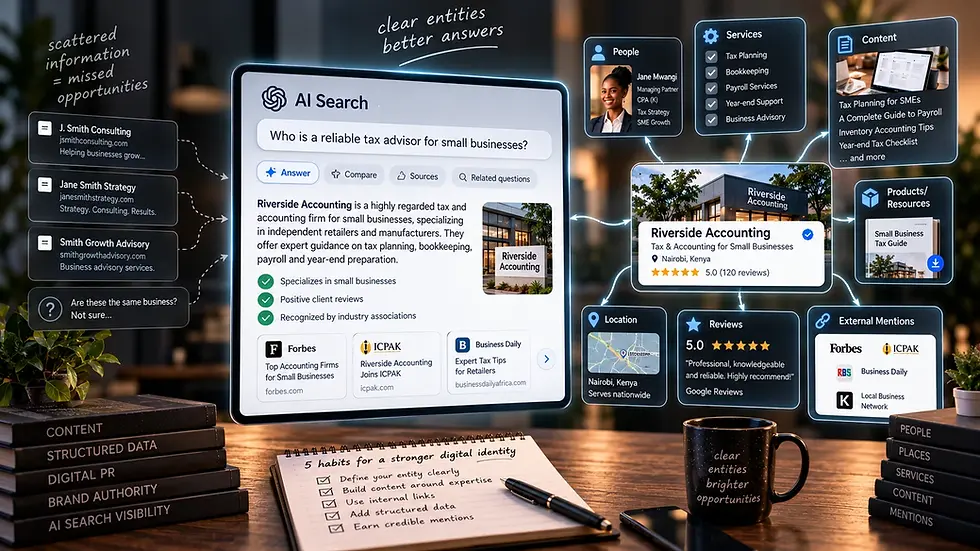
The practical path to stronger entity presence
A strong entity presence comes from disciplined clarity. It does not require a large team. It requires consistent facts and connected content. And once those foundations are in place, the next question becomes: how do you know whether your visibility is actually improving? That is where measuring AI search visibility becomes important.
Start with this checklist:
Audit your business name, address, phone number, founder names, service descriptions, and public profiles.
Rewrite your about page so it clearly states who you are, what you do, who you serve, and where you operate.
Create or improve author and founder pages.
Map your main services, products, and topics.
Link related pages together in a way that helps readers.
Add structured data for your organization, people, services, products, and articles.
Align public profiles with the same core description.
Seek mentions from credible, relevant sources.
Remove or update outdated claims, old addresses, and inconsistent descriptions.
Review entity signals whenever the business changes direction, launches a service, or enters a new market.
This is not a one-time technical task. It is a way of managing meaning.
Modern search rewards businesses that make themselves understandable. Keywords help people find topics. Entities help search engines understand identity. Relationships help them judge context and trust.
The future of search will not belong only to the loudest publishers or the largest websites. It will favor businesses and people that can be clearly recognized, accurately connected, and credibly cited.
Being found still matters. Being understood now matters more.


Comments