
AI Won't Replace Strategy. It Will Expose the Lack of It.

Artificial intelligence has become one of the defining business conversations of our time. Organisations are investing heavily in AI tools, employees are learning how to use them, and headlines continue to debate which jobs, industries, or professions will change next.
Yet beneath all the excitement lies a question that receives far less attention:
What happens when AI meets a business that lacks direction?
For years, organisations have blamed technology for poor performance. The CRM wasn't powerful enough. The analytics platform didn't provide enough insight. The project management software lacked the right features. AI is quickly becoming the latest addition to that list.
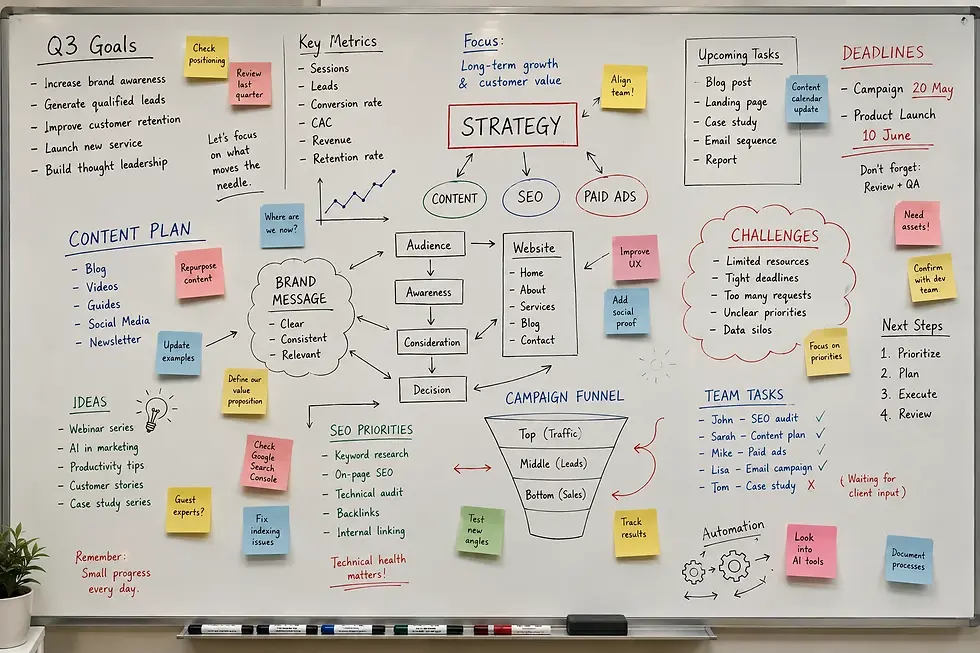
But perhaps the most interesting thing about AI isn't what it can do. It's what it reveals.
Unlike previous technologies, AI doesn't simply automate work. It exposes the quality of the thinking behind it. Businesses with clear strategies, well-designed systems, and intentional leadership often use AI to create remarkable results. Those without these foundations rarely solve their problems through AI alone. Instead, they discover that technology faithfully amplifies the confusion, inconsistency, and uncertainty that already existed.
The real question isn't whether AI will replace strategy. It's whether organisations have invested enough in strategy before asking AI to accelerate it.
Why Strategy Matters More Than Ever in the Age of AI
Artificial intelligence is often praised for making businesses faster, more productive, and more efficient. Those benefits are real. But speed, on its own, has never been a competitive advantage.
A business moving quickly in the wrong direction doesn't become successful because it moves faster. It simply reaches the wrong destination sooner. This is where strategy becomes indispensable.
AI can analyse markets, generate business plans, recommend campaigns, and suggest countless ideas within seconds. What it cannot do is decide which direction deserves an organisation's time, resources, and commitment. Those decisions require judgement, experience, organisational priorities, and an understanding of the future a business wants to create.
Imagine two organisations adopting the same AI platform. One has spent years defining its customer promise, documenting its processes, and aligning every department around a shared vision. The other adopts AI simply because competitors are doing the same.
Both organisations have access to identical technology. Their results won't be identical.
One is using AI to strengthen an existing strategy. The other is asking AI to compensate for the absence of one.
As AI continues to evolve, the businesses that benefit most won't necessarily be those with the newest tools. They'll be those with the clearest direction.
This principle extends beyond AI adoption. Organisations that constantly chase every new marketing trend often experience the same challenge: activity increases, but progress doesn't. As explored in The Hidden Cost of Chasing Marketing Trends, sustainable growth comes from strategic consistency rather than reacting to every new opportunity.
The Difference Between Strategy and Execution
One of the most persistent misconceptions about AI is the belief that exceptional execution can compensate for weak strategy. It can't.
Imagine two construction teams. Both are highly skilled. Both work efficiently. Both have access to the same equipment. The first team receives a detailed architectural blueprint before laying a single brick. The second is simply told to "build something impressive."
The difference isn't effort. It's direction. Business works the same way.
Strategy answers the questions that determine where an organisation is going.
What problem are we solving?
Who are we solving it for?
What makes us different?
Which opportunities deserve our attention?
What should we deliberately choose not to pursue?
Execution is what turns those decisions into action.
This is where AI excels. It can analyse information, automate repetitive work, generate content, summarise research, and accelerate countless operational tasks.
But AI doesn't decide whether those activities move the organisation towards the right destination. It executes the decisions people have already made.
If those decisions are unclear, contradictory, or poorly prioritised, AI won't correct them.
It will simply execute them faster.
How AI Exposes Organisational Weaknesses
Perhaps the greatest value AI brings to an organisation isn't automation. It's visibility.
AI is less like an employee and more like a mirror. It reflects the quality of an organisation's thinking. Clear strategy produces consistent outputs. Confused strategy produces confused outputs.
When documentation is incomplete, AI reveals the gaps. When departments pursue competing priorities, AI reflects the inconsistency. When brand messaging changes from one campaign to the next, AI doesn't resolve the contradiction. It reproduces it.
Technology rarely creates organisational problems. More often, it makes existing problems impossible to ignore.
This explains why two organisations using similar AI tools can experience completely different outcomes. The difference usually isn't the technology. It's the quality of the leadership, systems, decision-making, and organisational clarity surrounding it.
AI doesn't replace those foundations. It makes their absence more visible than ever before.

The same principle applies to AI-powered search. Search systems don't simply reward businesses for publishing more content; they evaluate clarity, expertise, structure, and trust. As discussed in How AI Search Decides Which Websites to Mention, AI increasingly favours organisations that demonstrate clear expertise and well-organised information rather than those producing content without direction.
Why Strong Systems and Documentation Are Essential
Every AI system depends on context. People naturally build context through conversations, experience, observation, and institutional knowledge. AI doesn't. If critical business knowledge exists only in the minds of experienced employees, AI has very little reliable information to work with.
This is why documentation matters far more than many organisations realise. Clear workflows, defined responsibilities, documented processes, and consistent standards provide AI with the context needed to produce reliable outcomes.
Without that foundation, inconsistency becomes inevitable. Marketing teams create conflicting messages, customer support delivers different answers to similar questions, and projects drift because everyone interprets the work differently.
Documentation isn't bureaucracy. It's organisational memory. It preserves knowledge, creates consistency, and enables both people and technology to work towards the same objectives.
The same principle applies to digital assets. A website isn't something you build once and forget. Like internal systems, it requires ongoing maintenance, refinement, and documentation to remain effective. As I explored in Website Maintenance for SEO: How Neglecting Your Website Hurts Rankings, sustainable performance comes from consistently improving what already exists rather than relying on one-time efforts.
As organisations adopt more AI, documented systems become one of their greatest competitive advantages.
How Leaders Should Prepare Their Businesses Before Adopting More AI Tools
Before investing in another AI platform, leaders should pause and ask more fundamental questions.
If AI disappeared tomorrow, would the organisation's strategy still make sense?
Could every department explain its priorities in the same way?
Are processes documented well enough for someone new to follow?
Do employees understand why decisions are made, or only what they're expected to do?
Are teams trying to automate work they haven't yet improved?
The answers to these questions reveal far more about an organisation's readiness for AI than the number of AI tools it has purchased.
Successful AI adoption begins long before technology is introduced. It starts with strategic leadership that focuses on five essential priorities:
Clarify business goals and customer value so every AI initiative supports meaningful business outcomes rather than creating activity without purpose.
Develop and document business systems with clear workflows, standards, and responsibilities that provide AI with reliable context.
Align teams around shared priorities to ensure departments work towards the same objectives and avoid conflicting outputs.
Invest in employee training and change management so people understand not only how to use AI tools but when and why to use them.
Review AI outcomes regularly to identify unintended consequences, measure impact, and refine strategy as the organisation evolves.
When these foundations are in place, AI becomes a powerful accelerator of progress. Without them, it simply accelerates confusion.

Artificial intelligence will continue to reshape how organisations work, but it will never replace the thinking that gives work meaning.
Every generation experiences technologies that promise to make work faster and easier. AI is different because it doesn't simply reward efficiency. It rewards clarity.
Businesses with a clear strategy, intentional leadership, and well-designed systems will use AI to strengthen what already makes them successful. Those without these foundations may discover that technology doesn't solve uncertainty. It amplifies it.
The organisations that thrive won't necessarily be those with the most advanced AI.
They'll be the ones that know exactly who they are, where they're going, and why. AI won't replace strategy. It will expose the absence of it.


Comments